Over recent years, global and domestic investment markets have been shaped by heightened volatility, persistent inflationary pressures and shifting monetary policy. These conditions have reinforced the importance of disciplined investment processes, sound portfolio construction and effective risk management in achieving sustainable outcomes for investors.
Fund managers have had to operate within an increasingly complex environment characterised by macroeconomic uncertainty, sharp market dispersion and ongoing geopolitical tensions. Elevated interest rates across major economies, supply chain disruptions, fluctuating commodity prices and currency volatility have created challenging market conditions, while conflicts in key regions, shifting trade dynamics and uneven global growth have added further instability. Against this backdrop, effective active management has required a combination of rigorous research, disciplined valuation and the flexibility to adjust portfolios while remaining anchored to long-term investment principles.
As Profile's Head of Fund Data Research, I am extremely honoured to present Profile's 2026 Unit Trust Awards. This is the second consecutive year that the awards have been featured in Business Day, reflecting the important role that independent, rules-based assessments of fund performance play in the industry.
 Yasmeen Butler
Profile's Unit Trust Awards recognise not only outstanding returns, but also the investment discipline underpinning those results. Funds are evaluated using two core measures: straight performance over three-years and risk-adjusted performance over five-years, to the end of December 2025. This approach ensures that results are assessed across full market cycles, rather than being influenced by short-term market conditions or excessive risk-taking.
Behind every award-winning fund is a team that often operates outside the spotlight. Fund managers, analysts, risk specialists and operational professionals play a fundamental role in shaping investment decisions, managing risk and maintaining the integrity of investment processes that support consistent long-term outcomes.
Profile extends its sincere congratulations to all the award recipients and commends the exceptional fund managers and their teams that are being recognised this year. We look forward to seeing how their achievements will continue to raise the standard and inspire progress across the industry.
 David Hansford
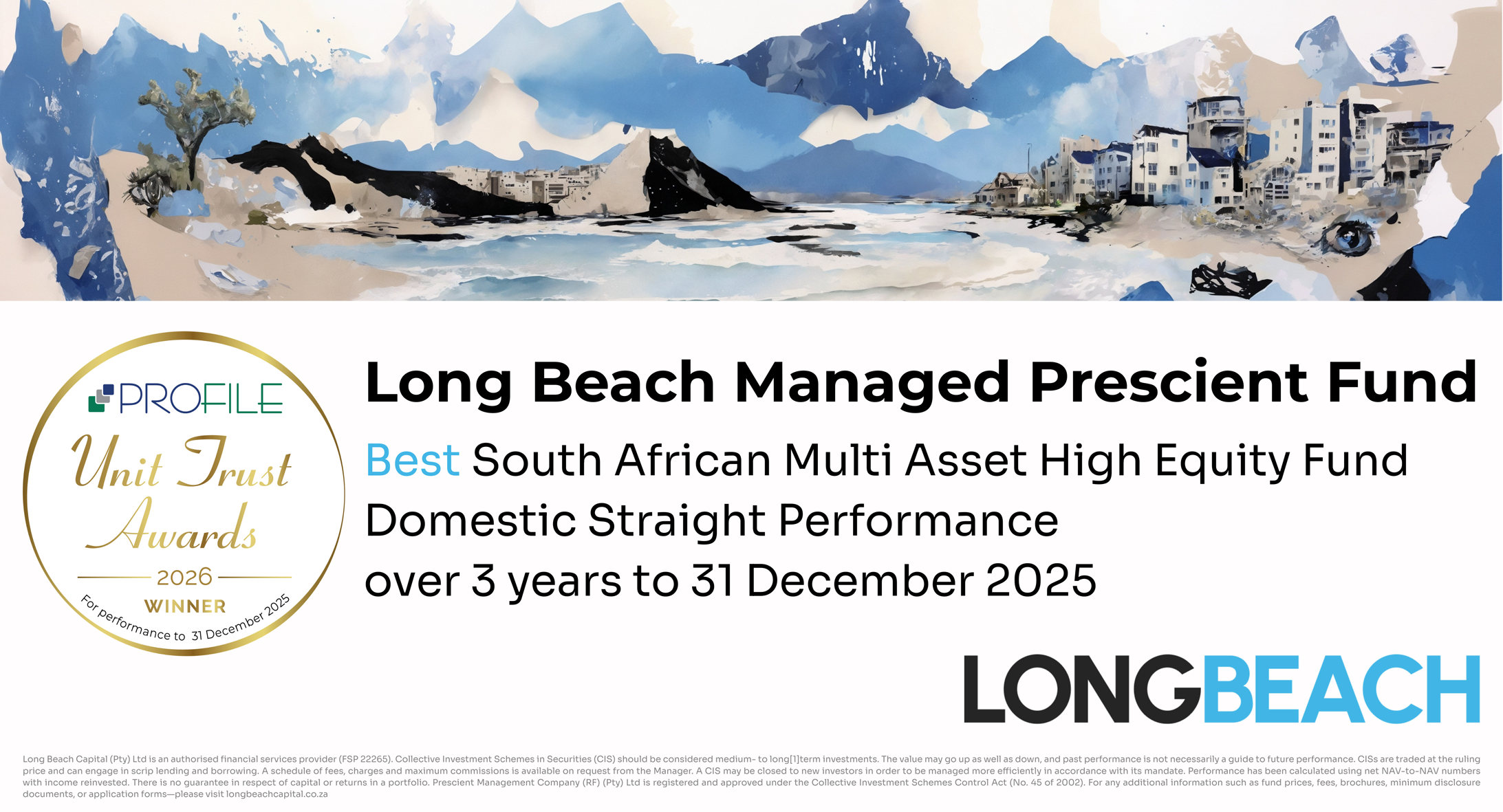
Long Beach's investment philosophy is to focus on the long-term ownership of exceptional businesses. These are companies with a sustainable business franchise, are capital-light, benefit from structural growth trends, have strong margins and cash flow, experienced management teams and a commitment to innovation. While geopolitical noise and market turbulence have increased in the last few years, Long Beach's focus of seeking out exceptional businesses, and investing for the long-term is unchanged.
Notable contributors to the Long Beach Managed Prescient Fund's performance over the award period were Cloudflare, Shopify, Richemont, Naspers, Uber, Alphabet and NU Holdings, which have all been long-term holdings in the Fund. Long Beach stays focussed on the underlying business progress of the companies in which we invest, while filtering out all unnecessary noise.
Long Beach is a boutique investment management company, and as such Long Beach has the independence and freedom to make investment decisions, and construct portfolios, solely in the best interest of our clients, without any distractions or outside influence.
David Hansford, Long Beach's founder and CIO, has managed the Long Beach Managed Prescient Fund for almost 13 years, since inception in 2013. David has managed the Long Beach Worldwide Flexible Prescient Fund since inception in 2009, almost 17 years, with a wealth of experience through multiple market cycles and environments. These two factors give Long Beach the unique edge of both experience and agility to navigate financial markets on behalf of clients.
Investing for the long-term allows 'compounding' the 8th wonder of the world (Albert Einstein) to work for investors' benefit and will always be a good foundation. Investing in great companies which use technology to innovate, adapt, move into new markets either vertically or horizontally, and strengthen their core business franchise is the best investment strategy for an uncertain world. While geopolitics and news headlines can seem overly negative with insurmountable challenges, Long Beach believes investing with an optimistic outlook and trust in the human capacity for innovation and problem-solving leads to the best investment outcomes.
2025 will go down as the year artificial intelligence (AI) emerged as a dominant theme for markets and broader society. While this is most likely the correct view, its effect on markets, entire sectors and individual businesses is harder to predict with confidence. There will be sectors that are disrupted, while some may not even exist in five years. If historical periods of great disruption are anything to go by, new industries, businesses and jobs will be created.
We are focused on what the large imbalance between Chinese production and consumption means for industries globally. This is alongside an increased focus on resilience for nation-states. The final large theme is the AI capital expenditure of hyperscalers, such as Amazon, Meta, Microsoft and Alphabet. The amounts that have been and are projected to be spent on chips and data centres are staggering. The big seven tech companies are collectively forecast to spend between US$500bn and US$650bn in 2026. This spending has contributed a not-insignificant amount to US economic growth.
At home, many SA Inc. shares have given up a significant portion of their post-election rally as reality has set in on their growth prospects. We are finding some intriguing opportunities in this area, such as in the depressed retail sector. It is also interesting because of the divergence in their performance when compared with the bond market, which has continued to rally strongly, while SA Inc. shares have lost momentum.
We continue to find value in high-quality multinationals, such as Anheuser-Busch InBev and British American Tobacco, which have underperformed the precious metal miners.
Risk remains heightened across the board, and we remain concerned about the elevated level of global sovereign debt and geopolitical tension. We are bottom-up investors, but we strive to be on the right side of long-term trends. This is easier said than done. Our Investment team continues to apply the same philosophy and process we have adhered to for the last 52 years in managing our clients' hard-earned savings: We hunt for companies priced below our estimate of their true worth and sell them when they reach fair value.
It is worth highlighting that last year's overall market returns are well above what we consider normal. The market has done a lot of heavy lifting for our portfolios, which won't always be the case, and we have a strong contribution from the offshore portion of our portfolio, which is mostly managed by our offshore partner, Orbis.
We encourage investors to focus on their long-term financial plans and goals rather than worrying about the daily news cycle - as challenging as this may be. Long-term investing proves most fruitful for those who manage to stay the course.
Geopolitical change, fragmented trade, rapid technological adoption and extreme index concentration are fundamentally reshaping the world. Many markets are outperforming - although performance is heavily concentrated in a handful of big names. In moments like this, the ability to adapt really matters. Orbis' strength is not in predicting the future - it is in adjusting to whatever comes next while staying true to their principles and values.
In practice, this means sticking to what they have always done: finding good businesses that others have overlooked or misunderstood, especially when the market is distracted by loud narratives. Orbis looks for management teams that can adapt as technology and incentives evolve. They focus on resilience - seeking companies at a price that includes a margin of safety that does not depend on everything going perfectly.
Orbis President Adam R. Karr points out that performance in any given year reflects decisions made years before. Recently, several of Orbis' long held positions shifted from being headwinds to tailwinds: owning value stocks outside the US, being overweight emerging markets, and staying underweight the US dollar. Their stock picking has added meaningful value.
Orbis is an active, valuation oriented investor. Their goal, shared with their sister company Allan Gray, is simple: Own solid businesses at prices well below what they think they are worth - even if that means looking nothing like the index. Being out of step can feel uncomfortable, but it is often necessary to compound returns through a full market cycle.
In the past few years, investor excitement - and money - has flooded to anything linked to AI. Like previous tech waves (PCs, the internet, mobile, the cloud), this has sparked real innovation but also pockets of speculation. As a result, markets are not priced cheaply at the index level. The surest way to lose client capital is to overpay for an asset. In this environment, Orbis believes a focus on company-specific fundamentals and resilience is key.
While the market is obsessed with today's winners, which are mainly in tech, Orbis has found appealing opportunities in unloved areas of the market, such as healthcare. Performance in the sector is often driven by company specific factors - such as research output, clinical results, regulatory decisions, execution and capital allocation - which reward disciplined, bottom up analysis. This plays directly to Orbis' strengths, and they are finding attractive opportunities in selected businesses including Genmab, Bruker and ICON.
Markets did well in 2025, but the backdrop is tricky. Valuations are stretched and index concentration is near historic highs. Orbis' approach offers something different: They look for durable cash flow businesses, sensibly priced, diversified across regions and currencies, and built to adapt. Protecting client capital is Orbis' priority. They remain focused on intrinsic value, robust risk assessment, and backing leadership teams that can navigate change.
 Shaun le Roux
Over the past five years, we had to navigate the Covid pandemic, a new government in SA, a new global geopolitical regime and wars (both hot and cold). Uncertainty is a constant feature of investing, but there are periods when change is accelerated.
With all the focus on AI, good returns from this area over the past few years, and rapid change in technology, we think a major shift in investment regimes is being overlooked. We expect the market winners of the future to look very different to the winners of the past. We anticipate multi-year outperformance from emerging markets and value stocks. This bodes well for our clients. PSG Asset Management has been investing directly offshore since 2008 and our globally integrated process allows our managers to select the best opportunities from around the globe. We believe this approach has contributed to the success of our funds, including that of the PSG Equity Fund.
We have the benefit of leaning on an unwavering investment philosophy and process, cumulative experience and an open mind to
deliver good outcomes for our clients. Our consistent 3M investment process has proven that it can be applied to different market conditions. Its focus on long-term value allows us to leverage times of great fear or disruption as important buying opportunities to acquire mispriced, quality assets.
We are prepared to look in unpopular areas for opportunities, do our own research and be brave and patient. We have leveraged our global capability to find excellent investment ideas around the world, often in deeply out-of-favour parts of the market. This recipe has enabled us to deliver ongoing investment excellence for our clients to date, and we remain committed to doing so into the future.
Disclaimer: Full details of the PSG Equity Fund are available at https://www.psg.co.za/asset-management/fact-sheets. Affiliates of the PSG Financial Services Group, a licensed controlling company, are authorised financial services providers. PSG Asset Management (Pty) Ltd is an authorised financial services provider. FSP 29524
 Philip Bradford
The pressure to react has never been higher. Each market cycle brings new themes, new tactical shifts, and claims that old rules no longer apply. When gold surges, the question becomes whether portfolios should tilt toward mining. When sentiment on South Africa improves, investors wonder if they should reduce offshore exposure and increase domestic holdings. When equities rally on political developments, the debate shifts to whether it's time to chase the move. The noise is constant.
The result is rarely better outcomes. More often, it leads to decisions made at exactly the wrong time.
What has changed is not the objective of investing. It remains about funding long-term goals. What has changed is the illusion that portfolios must constantly adapt to remain effective. In practice, this behaviour undermines the consistency that long-term financial plans depend on. The answer is not innovation for its own sake. It is conventional investment management, applied with rigour. Conventional in the traditional sense: broad diversification, careful portfolio construction, and a clear long-term horizon. These principles remain the most reliable way to invest through uncertainty because they are designed around what actually matters, funding the goal, not reacting to the latest headline.
At the centre of this approach is a simple discipline. Investors should take only the risk required to meet their objective. Not more, chasing returns beyond what the goal demands. Not less, fearing drawdowns. The portfolio should be built to deliver the return needed, with the level of risk that allows the investor to stay invested when markets are uncomfortable.
Philip Bradford, PortfolioMetrix's Chief Investment Officer in South Africa, is direct: “The biggest mistake we see is investors changing their portfolio in response to market movements, when their actual goal hasn't changed at all. The real risk is not market volatility. It is discovering, too late, that the portfolio was taking risks that were never aligned to the goal.”
This discipline matters across the investment landscape. Institutional investors benefit from clearer governance and fewer reactive changes. Retail investors gain portfolios they can hold through drawdowns without abandoning their plans. Financial advisers are able to focus on progress towards long-term objectives rather than defending short-term noise.
Bradford adds: “Uncertainty is unavoidable. Our responsibility is to build portfolios with enough discipline to keep investors composed and invested through different market cycles.”
In a world increasingly driven by reaction, the advantage lies with those who stay conventional. Portfolios built for the goal, not the headline. Risk matched to what you're actually trying to achieve. Strategies designed to support consistency over time. That is what traditional investment management looks like when it is done properly.
 Edo Bräsecke
The past few years have presented one of the most complex investment environments in decades. Global inflation shocks, aggressive monetary tightening, geopolitical tensions, commodity super cycles, and shifting capital flows have driven rapid rotations between value, growth, defensives, and resources. Locally, political uncertainty and structural constraints added another layer of volatility.
Against this backdrop, we are proud to have been recognised with the Methodical BCI Global Dynamic Fund as the Best Fund in the Global-Multi Asset-Flexible sector, in the 3 Years Straight Performance category, an acknowledgement of the consistency, discipline, and transparency of our investment process during a period marked by sharp and unpredictable style shifts. For us, the award is not a celebration of a single moment, but of the long-term commitment we have made to a systematic, data-driven approach.
At Methodical, our philosophy is grounded in the “wisdom of crowds”. Share prices reflect the aggregated views of thousands of market participants. Rather than attempting to predict macro outcomes, we systematically measure where capital is flowing and position accordingly.
“Our job is not to forecast the future, but to listen to what the market is telling us and align with the strongest trends.”
Price momentum, what we refer to as the “chameleon factor”, proved critical. When value led, we looked like a value fund. When growth
dominated, we resembled a growth fund. More recently, strong commodity cycles resulted in meaningful exposure to basic materials. This dynamic adaptability, unconstrained by style labels or benchmark weights, enabled us to participate in sustained trends while exiting weakening positions. It is this consistency of process, rather than any single decision, that underpinned the performance recognised by the award.
Our differentiation lies in disciplined portfolio construction. We start with the 60 most liquid shares on the JSE and rank them by momentum, holding only those driving performance. We are benchmark agnostic and size positions based on opportunity, not index weight. When broad market conditions deteriorate, we deploy robust risk controls to manage downside risk. This clarity of framework and the transparency it provides to clients remains central to who we are..
Looking ahead, we believe systematic, data-driven processes will become increasingly important as markets accelerate and information flows intensify. Investors will continue to demand transparency, discipline, and repeatability. Our focus remains on refining our models, enhancing execution, and scaling responsibly, always guided by market signals rather than opinion.
This recognition affirms the value of our approach, but it does not change our philosophy. If anything, it strengthens our commitment to remain disciplined, adaptive, and aligned with the evidence the market provides; it's Investing with Evidence, not Opinions.
 Raihan Allie
The past few years have delivered no shortage of complexity - post-Covid inflation, aggressive global rate hikes, the uncertainty of a domestic GNU, and Trump's return bringing tariff risk and dollar uncertainty back into the picture. Each episode was different, but our response was consistent - assess the environment carefully, identify where risk is being mispriced, and stress-test the downside. While duration occasionally looked attractive in isolation, funding it by reducing our high-quality bank credit exposure never made sense on a risk-adjusted basis. More recently, as domestic credit spreads have tightened and opportunities diminished, we have selectively introduced offshore exposure - hedging out the currency risk - to ensure our clients continue to be adequately rewarded while avoiding undue risk.
Superior long-term returns are built on avoiding losses as much as finding winners - a belief that sits at the heart of all our strategies. Our process demands that we spend equal time stress-testing the downside of every investment decision as we do building the upside case. By identifying securities with return distributions skewed to the upside - and steering clear of those with fat negative tails - we protect capital without sacrificing return potential. In practice, this is reflected in our portfolio positioning. Most of our holdings are in South African
bank credit - institutions with strong, well-capitalised balance sheets that have continued to strengthen - a deliberate expression of our conviction in the underlying credit quality of our issuers.
Three things define Truffle's edge: our size, our agility, and the depth of our integrated investment team. Being a smaller manager in the South African market is a structural advantage. We can be selective in a way that larger peers simply cannot. Our flat team structure eliminates committee-driven inertia. Decisions are well-researched and honestly debated but executed with speed when opportunity arises. Finally, our fixed income team operates shoulder-to-shoulder with Truffle's equity analysts daily. That cross-pollination of insight enriches every investment decision we make.
Value in the years ahead will be delivered by navigating the increasing divergence between local and global risks. We are witnessing a historic role reversal: South Africa is entering a virtuous cycle of lower inflation, fiscal consolidation, and political friction, while developed markets face a vicious cycle of unsustainable debt, political instability and lower growth. As the quality gap between EM and DM debt blurs, the ability to capitalise on South Africa's improving fundamentals through active, high-conviction selection while shielding portfolios from global instability will be the most prominent theme for fixed-income investors.
 Jonathan du Toit
The past year has tested investors on multiple fronts. South African markets navigated a volatile global backdrop of elevated interest rates, slowing growth, and persistent geopolitical tension, alongside a rising gold price as investors sought safe-haven assets. Markets also contended with election uncertainty, fragile consumer confidence, and the after-effects of years of load-shedding. Although operational conditions began to stabilise in 2024 as energy constraints eased, sentiment remained highly reactive, with sharp style rotations, commodity price volatility, and pronounced dispersion between sectors.
Against this backdrop, the central challenge was separating temporary noise from permanent impairment. Election risk, fiscal concerns, and global rate uncertainty often triggered exaggerated market reactions, particularly among domestically exposed stocks and SA-listed multinationals. These conditions reinforced the importance of maintaining perspective and applying discipline, rather than responding to sentiment-driven volatility.
“Volatility is not the enemy of long-term investors. It is the source of opportunity.”
Oyster Catcher's valuation-based philosophy proved critical during this period. Our bottom-up approach to establishing intrinsic value allowed us to normalise earnings through the cycle, identify businesses facing temporary headwinds, and avoid those where fundamentals were genuinely deteriorating. A real-time ranking table ensured that all opportunities were consistently assessed on expected risk-adjusted return, while our proprietary momentum indicator guided the timing and sizing of positions. This combination enabled us to remain invested when valuations were compelling, while exercising caution where returns were driven primarily by rating expansion rather than earnings growth.
What differentiates Oyster Catcher is not a single insight, but a repeatable and disciplined process. Our focus on many appropriately sized, independent positions reflects a clear acknowledgment of uncertainty and a belief that consistent alpha is generated through diversification and risk management, not concentrated bets. Looking ahead, as inflation moderates and rate expectations evolve, dispersion will continue to create opportunity. In an environment shaped by complexity, discipline remains the most durable edge.